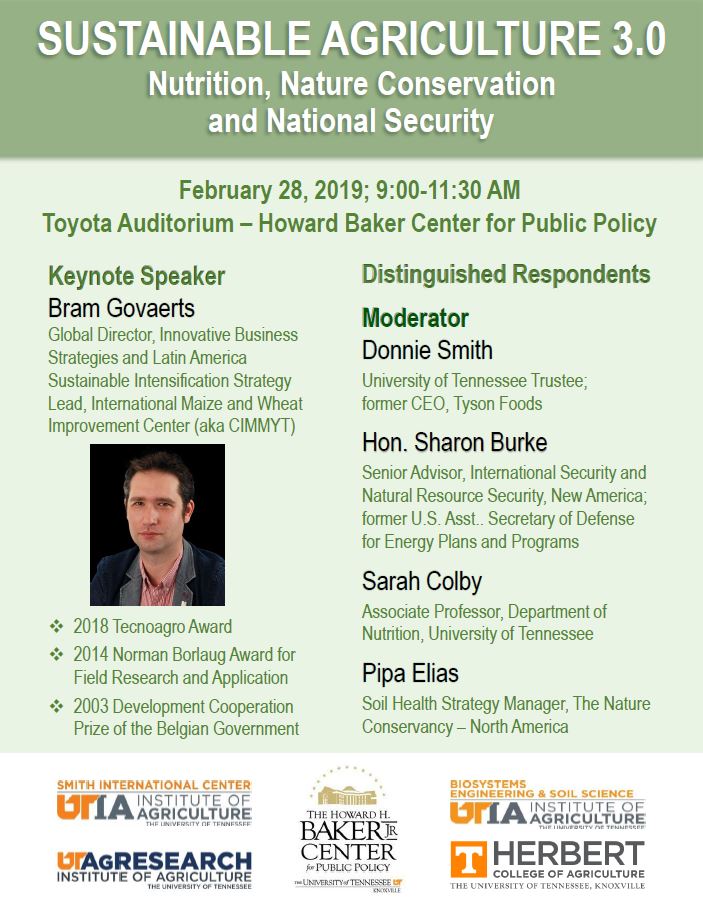
Thursday, February 28, 2019
Toyota Auditorium, Howard Baker Center for Public Policy, University of Tennessee, Knoxville
09:00 – 09:05
Welcome and introduction of Dr. Bram Govaerts, Global Director, Innovative Business Strategies and Latin America Sustainable Intensification Strategy Lead, CIMMYT (International Maize and Wheat Improvement Center)
09:05 – 10:00
Keynote presentation, Dr. Bram Govaerts
10:00 – 11:20
Panel discussion with Q&A
Moderator: Donnie Smith, former CEO, Tyson Foods
Panelists:
Hon. Sharon Burke, Senior Advisor, International Security and Natural Resource Security, New America
Sarah Colby, Associate Professor, Department of Nutrition, University of Tennessee
Pipa Elias, Soil Health Strategy Manager, The Nature Conservancy, North America
11:20 – 11:50
Bio-break and travel to UTIA campus for lunch and afternoon workshop
The afternoon continues with an invite-only workshop on UTIA campus.
ABOUT SA3
In the 1950s and 60s, the Green Revolution increased the yields of cereal crops to such an extent that billions of people were saved from starvation throughout much of the developing world. Technological developments in subsequent decades further improved production efficiency. These periods of improved agricultural production have largely kept pace with global population growth and improved soil quality and conservation. If these two phases of productivity intensification are versions 1.0 and 2.0 of sustainable agriculture, then what comes next? By 2050, the world population is expected to grow by 20 to 30 percent and food production will need to outpace this rate of growth, as per capita demand for calories and protein will also increase. At the same time, the Earth’s finite natural resources, particularly water and arable land area, are already strained. Climate change and energy insecurity present crosscutting challenges to the present order of the global food system. Against this backdrop, further increasing crop yields while maintaining or improving their nutritional value requires a new paradigm of sustainable agriculture. Sustainable Agriculture 3.0 (SA3) must intentionally confront the role of agriculture not only in delivering nutrition to a growing world population, but also in conserving natural resources for future generations, mitigating climate change, supplying energy, and enhancing security by strengthening resilience of the food system to shocks, such as extreme climate events and geopolitical disruptions. SA3 must be founded on a transdisciplinary framework that integrate across not just food, energy and water systems, but also social, economic, and political systems.
Thursday, February 28 at 9:00am to 11:30am
Howard H. Baker Jr. Center for Public Policy, Toyota Auditorium
1640 Cumberland Ave., Knoxville, TN 37996